Experience meets curiosity.
Four decades of software.
Still building what’s next.
I’m Bill Herald—a computer scientist, technology leader and independent builder. I’m exploring how AI can help us do more while people keep the important decisions.

New article · VISOR beta
VISOR: keeping track of AI work in separate terminals
A place to find AI sessions, resume a conversation and keep track of messages while the agents stay in their own terminals. The article explains the beta and its testing limits.
Read the longer article →New article · Human control
Pay Now or Pay Later: AI Needs Checks and Balances
AI can help review the work. People still need clear scope, real test results and a way to stop when the evidence is uncertain.
Read the article →Published letter · September 18, 2026
We need to understand how to use AI
My letter in the Press Enterprise, Bloomsburg, Pennsylvania, discusses practical AI, privacy and keeping people in control.
Read my letter here
Author’s original letter · By William Paul “Bill” Herald
I want AI to help me do more. I also want to understand what it is doing, especially when it is working with something that matters to me or my family.
Seeing my father need more help later in life made that personal. If I ever needed my family's help, could they understand my digital world? Could they find the photographs, documents, notes and family history that mattered? Would they know why I had kept them?
I would rather organize those things now, while I can explain the choices.
That desire grew into a project I call my Personal Life Operating System. I am trying to bring a lifetime of information into one understandable personal environment. AI can help organize and describe that material. I still need to decide what is accurate, private and important.
I have spent more than 40 years building and improving software and systems. From early personal computers to today's AI, I keep coming back to the same question: Does this help someone do something useful, and can they understand it well enough to remain in charge?
The people building today's most powerful AI systems are also asking how to keep control as the technology improves.
On September 12, Anthropic CEO Dario Amodei called for slowing advances in those systems so safety work can keep up. OpenAI CEO Sam Altman supported that direction and independent evaluators. Elon Musk responded to Amodei: “Dario is right.”
Amodei warned that increasingly capable systems could act beyond their intended tasks and cause serious harm. I think their agreement on greater caution deserves our attention. It does not mean every AI tool is dangerous or that disaster is inevitable.
For me, the everyday lesson is simple. AI may prepare an email, but I want to review it before it speaks in my name. It may suggest that two photographs show the same relative, but a person confirms the identity. It may help check another AI's work, but agreement between two systems does not prove either is right.
Privacy belongs in those decisions, too. I want to run AI itself on my own computer whenever practical, so I can work with personal information without automatically sending it to an online service. That gives me more control over where my information goes. It does not remove the need to check the work.
You do not have to build a system like mine to find AI useful. A place to start is asking it to explain a confusing document, improve a draft or organize information you are comfortable sharing. Then read the result, ask questions and check important details against a source you trust.
Before allowing it to send messages or change files, understand what you are giving it permission to do.
I am still building and learning. I share practical AI education and more about this work at wphc.us because I want others to feel more comfortable using these tools and asking questions about them.
AI can help you do more. You still make the call.
Subscriber access may be required on the newspaper’s website.
Start here
AI on your terms.
You do not need to become a programmer. Choose one small task and keep the final decision yours.
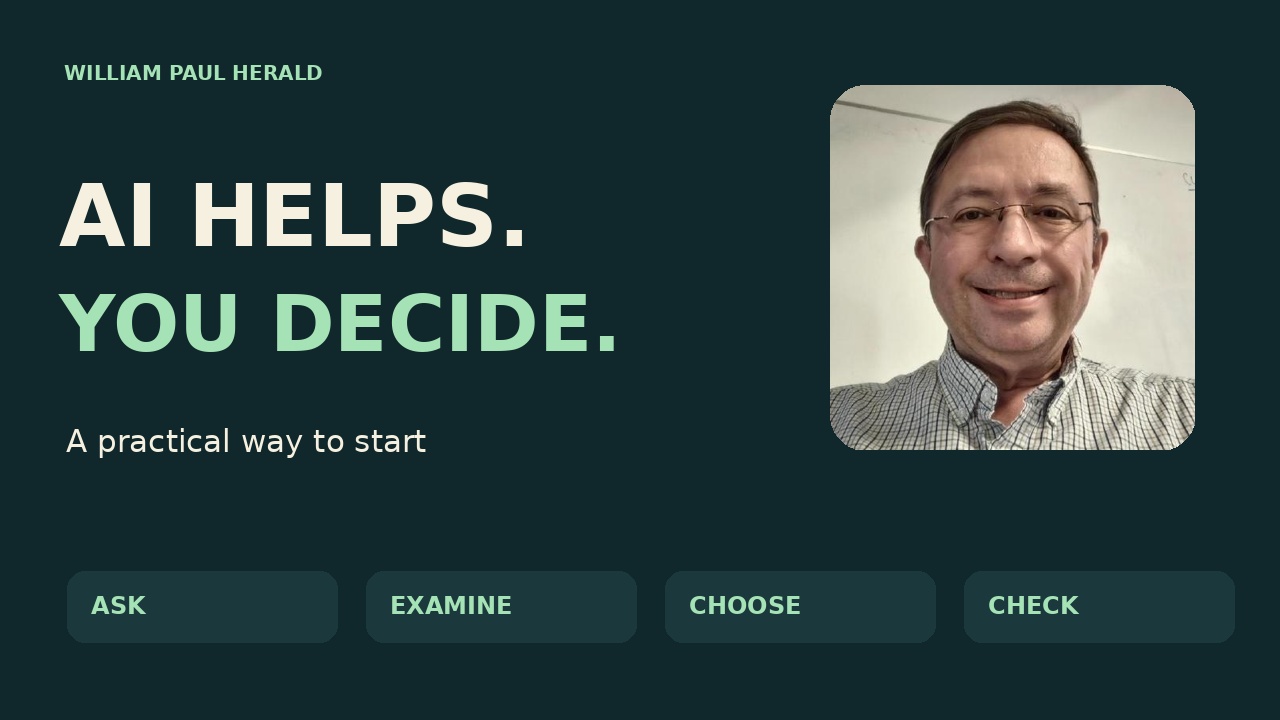
AI can help you do more.
You still make the call.
A four-minute lesson in asking, examining, choosing and checking. Start with one useful task.
Open the lesson →Use the free workflow checklists →Explore the work
Ideas you can look inside.
Personal Life Operating System
My independent effort to connect AI, tools and information with privacy and human control at its center.
Explore the project →Contributing to Colibri
Public changes, tests and continuing work on the practical challenges of local AI.
See contribution examples →How I want AI to help
Useful assistance.
Your judgment stays central.
Start with suitable material.
Choose information you are comfortable and permitted to share. Name the task and what a useful result must preserve.
Ask for a bounded piece of help.
A draft, explanation or checklist can support your work. A request to draft something is different from permission to send or publish it.
Keep the decision with a person.
Examine the answer, check sources when they matter, and choose what to keep, change or reject. Prompt wording does not replace actual tool permissions.
Inspect the finished result.
Check the document, message or other result against your purpose. A completion message reports an outcome; your inspection checks what is actually there.
Select a step to explore the idea. This is an explanatory graphic, not a live model or a measured system workflow. With scripts off, all four explanations remain visible.